
Miriam Cassel
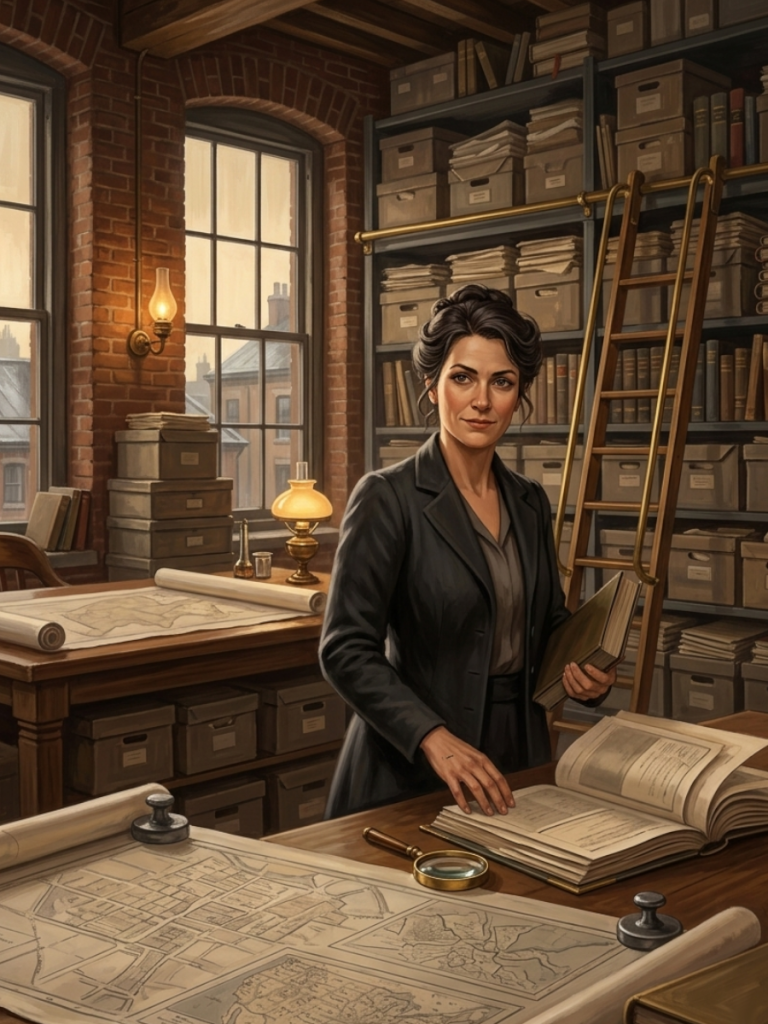
MIRIAM CASSEL Genealogist & Records Specialist · Third Floor, Eastgate Lane · University District
The University District has a long memory for people who leave on their own terms. Miriam Cassel left her lectureship at the height of her career, packed her methodology and her document maps into a converted textile warehouse on Eastgate Lane, and has been doing the work properly ever since. The University has not entirely forgiven her. Miriam has not noticed.
She occupies the third floor of a building that suits her perfectly — large enough for the work, removed enough from the street for concentration, close enough to the academic district to maintain the archive relationships she needs while remaining entirely free of the constraints that made those relationships impossible to sustain from the inside. The floor is covered in document maps, rolled and weighted at the corners in the manner of someone who has developed a precise system that looks, to the uninitiated, like productive chaos. It is not chaos. Everything is exactly where Miriam knows it to be, which is the only index that matters.
She is in her late forties, sharp and vigorous, with the particular energy of someone who made a significant decision and has found, consistently, that it was the right one. She left academia not out of disillusionment but out of impatience — the constraints were real, the bureaucracy was genuine, and the work was too important to spend another year explaining itself to a committee. She is warm in the way that people are warm when they have stopped performing warmth for institutional purposes and returned to the real version — direct, interested, occasionally surprising in what she finds funny.
She returns with more than was asked for. This is not excess — it is Miriam’s standard of completion. A question asked of her is a question she will answer fully, which means following the thread wherever it leads rather than stopping at the point where the commission technically ends. Clients who engage her for a narrow search frequently receive, along with the answer they requested, three adjacent pieces of information they did not know they needed. The rate remains fair regardless.
She gave Nala the approving look before she looked at Tim on their first meeting. She still does, at every subsequent meeting, without variation or self-consciousness. Nala receives it without expression and files it as accurate. Miriam has never explained the habit and Tim has never asked — some professional assessments speak for themselves.
Her contribution to the Understone case was the kind of archival work that looks straightforward only to people who have never tried it — finding a Continuance Act classification mark on Meridian Survey overlays buried in university archive materials that had no reason to be connected to anything current. It was the thread that made everything else possible. She located it, identified its significance, and delivered it in the correct order with the additional context that made Bernard’s mechanism workable. This is what Miriam Cassel does. She finds the thing that is there when everyone else has concluded there is nothing to find.